"The global decarbonization targets set for 2030 are not easy, but they are achievable."
January 14, 2022
"The global decarbonization targets set for 2030 are not easy, but they are achievable."
January 14, 2022
"The global decarbonization targets set for 2030 are not easy, but they are achievable."
January 14, 2022
States the expert at the Round Table "FIT FOR 55, the EU package that will boost climate action," organized by ANESE (National Association of Energy Service Companies) and COIIM (Official College of Industrial Engineers of Madrid)
Climate change requires an immediate response from society and the business community to curb the consequences of this serious problem affecting the planet. According to Laura San Segundo, Head of Energy Management at EDF Fenice, at the Round Table "FIT FOR 55, the EU package that will boost climate action," organized by ANESE and COIIM, "we are living in a time of climate emergency that has begun to be addressed globally, with measures tackling climate change and decarbonization strategies that are yielding results. At EDF Fenice, we are convinced that it is possible to achieve the Fit for 55 objectives, even if they are not straightforward."
This European roadmap lays the foundations for a transition towards renewable energy sources, with the goal of achieving a 55% reduction in global emissions, although states will have a weighted target based on their GDP.
In Spain, for example, this emission reduction target is set at 23% of its gross domestic product, according to the Integrated National Energy and Climate Plan (PNIEC) 2021-2030. With the modification introduced by Fit for 55, this target is even raised to accelerate the transition towards cleaner energies.
The European agenda sets a timeline up to 2050 and, for example, the new independent emissions trading system for buildings and road transport will not come into force until 2026, and the ban on marketing passenger cars or vans with internal combustion engines in the EU has been set for 2035.
As highlighted by the participants in the Forum organized by ANESE and COIIM, the European Union has become in recent years the main driver of measures against climate change, with the aim of achieving climate neutrality in its area of influence before 2050. As an intermediate step, the aforementioned "Objective 55" stands out to reduce emissions by at least 55% by 2030.
However, the challenge is global, as the European Union is only responsible for 8% of current global emissions, while China, Japan, and the United States are the main CO2 emitters on a global scale.
Laura San Segundo considers that the package of measures Objective 55, which reviews and updates current EU legislation, "is more than convenient and aligns with the climate objectives agreed upon by the Council and the European Parliament. But to meet these objectives, it is necessary to boost aid actions by increasing subsidies for energy efficiency, establishing a very strong link with digitalization. One of the most important actions to contribute to these objectives is to monitor consumption and make decisions based on data, since 'What is not measured cannot be improved'."
This energy transition is one of the factors behind the current rise in electricity bills, which is too closely tied to the price of gas and energy dependence, compared to the still limited contribution of renewable energies.
The most efficient solution, according to San Segundo, is to "accelerate the transition towards renewable energies and bet on energy efficiency solutions that allow consolidating energy independence from other more expensive and polluting generation sources."
The EDF Fenice expert also emphasized that "in recent years, alarm bells have gone off in different sectors due to the upward trend in the CO2 price, with more and more sectors being affected in the short term by the emissions market." In this line, the directive advises the business community to "develop decarbonization strategies that allow achieving climate neutrality by 2050, adhering to regulations such as the European Green Deal or the Fit-for-55 measures."
In fact, "significant improvements in energy efficiency have been achieved in industry in recent times. At EDF Fenice, as a global energy partner, we have accompanied our clients in improving their processes in terms of energy consumption and increasing the competitiveness of their products in the market. We have seen the great potential for savings due to high energy consumption both in heat generation and cold generation," adds San Segundo.
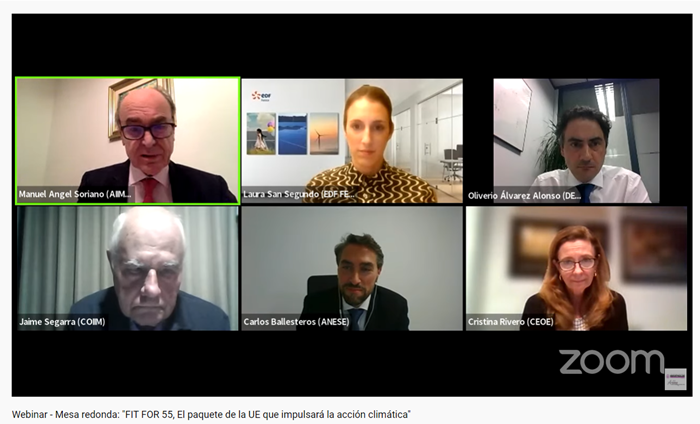
This discussion Forum, moderated by the director of ANESE, Carlos Ballesteros, was held yesterday online, with the participation of César Franco, Dean of COIIM; Oliverio Álvarez, Partner at DELOITTE; Cristina Rivero, head of the international area of AEMENER; and Jaime Segarra, President of the Energy Commission of COIIM, in addition to the aforementioned Laura San Segundo, Head of Energy Management (EMS) at EDF Fenice Ibérica. The event was closed by Manuel Ángel Soriano, Comptroller of AIIM (Association of Industrial Engineers of Madrid).