
At Edison Next, we remain committed to sustainability and energy efficiency through the development of projects that directly contribute to the transformation and modernization of cities. On this occasion, within the framework of the Action Plan for Sustainable Energy...
6 de May de 2026
Categorías: Press
Edison Next drives Alcalá Luce, innovation and sustainability to rediscover Alcalá de Henares at night.
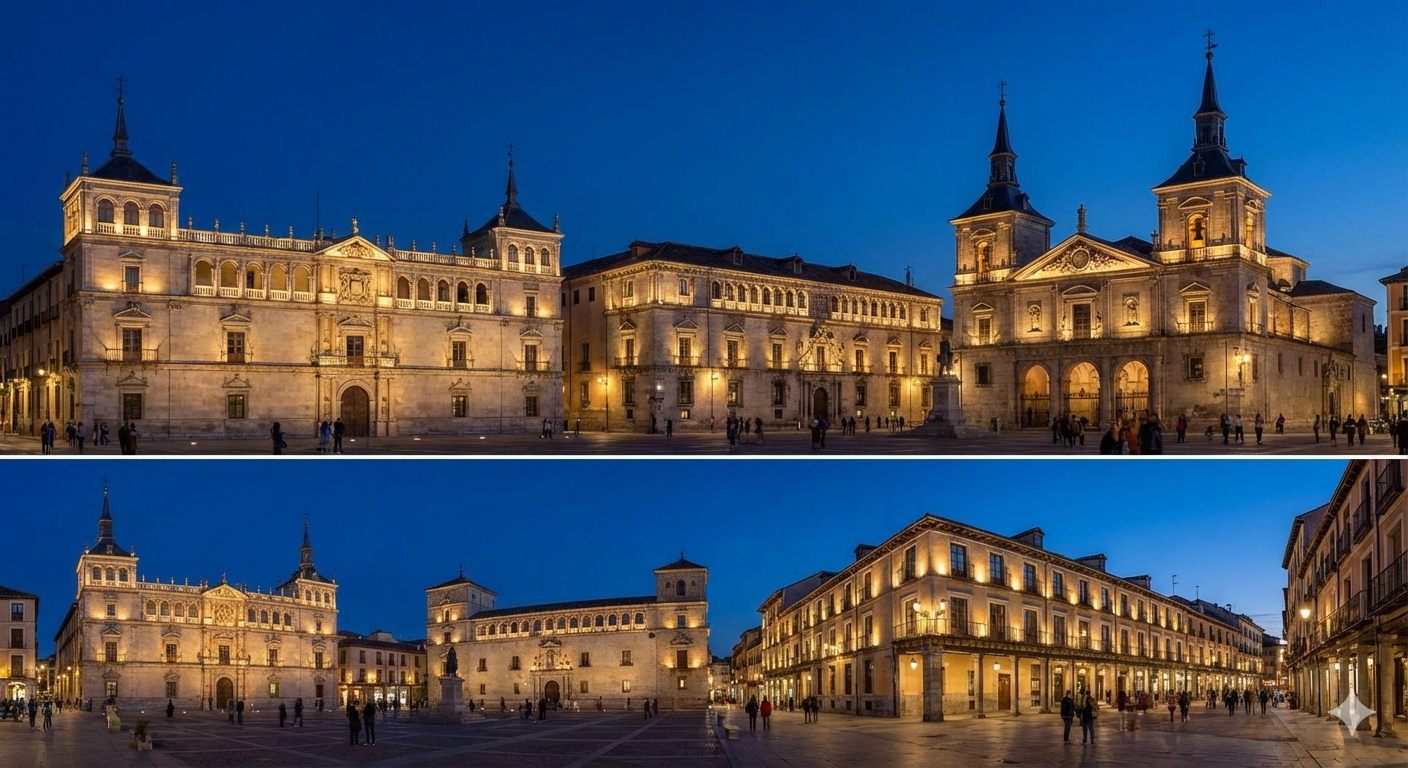
The City Council of Alcalá de Henares has launched one of the most ambitious monumental lighting projects in recent years. Under the name Alcalá Luce, the initiative proposes a new way of interacting with the city’s historical heritage, integrating criteria of sustainability, technological innovation, and heritage respect to transform the nighttime experience of the historic center.
Edison Next Spain will be responsible for developing this project, conceived not only as an aesthetic renovation of the lighting, but also as a comprehensive urban intervention in which light becomes a tool aimed at improving energy efficiency, reducing environmental impact, and enhancing the value of the Complutense architectural heritage.
One of the main challenges of Alcalá Luce is the work on a historic center of high cultural and architectural value, where many of the existing installations are obsolete or have limited visibility at night. The project will allow for the recovery of the nighttime presence of the city’s most emblematic buildings, improve the perception of volumes and construction details, and offer citizens a clearer and more coherent reading of the monumental complex.
From a technical point of view, Edison Next’s approach starts from the premise of intervening on the heritage with the least possible invasion. To this end, completely reversible solutions adapted to the characteristics of each building will be applied, combining high-efficiency LED technology, precise control of lighting levels, and respectful integration into the urban and landscape environment.
Alcalá Luce is structured around two main axes that, together, will configure a continuous nighttime route through the historic center. The first is developed in the area of Plaza de San Lucas, the main access point to the historic center from the train station. From there, the lighting renovation will advance towards Calle Libreros, reinforcing its role as a cultural axis and as a transition towards the monumental heart of the city.
The project sets a minimum reduction of 30% in greenhouse gas emissions compared to the previous lighting. This objective will be achieved mainly through the replacement of old luminaires with state-of-the-art LED technology equipment, along with intelligent control systems that will allow adapting the lighting to the actual use of the spaces and optimizing energy consumption.
The second axis of action is located in one of the most representative heritage areas of Alcalá de Henares, along the route that connects the Plaza de los Santos Niños with such emblematic sites as the Palacio Arzobispal, the Monasterio de San Bernardo, or the facade of the University of Alcalá. In this area, the new lighting will seek to visually organize the nighttime space, reinforce the cultural reading of the architectural complex, and improve the experience of residents and visitors.
To maximize its commitment to sustainability, the project also incorporates a photovoltaic installation aimed at reducing the consumption of non-renewable energy, reinforcing the energy efficiency approach that guides the entire action.
With an awarded investment of 567,672 euros, Alcalá Luce becomes a new way of approaching lighting in historical environments, understanding it as an intelligent, efficient infrastructure aligned with current environmental challenges. The project will help consolidate a more sustainable city model, in which technological innovation is put at the service of heritage and urban quality of life.
This ambitious project will allow building a new nighttime experience for Alcalá de Henares, in which light will act as a cultural guide, an element of urban cohesion, and a tool for energy efficiency.
For Edison Next, initiatives like Alcalá Luce reflect its special way of understanding urban lighting as a driver of sustainable innovation, capable of improving the citizen experience and accompanying public administrations in the transition towards more efficient, responsible urban models that respect their cultural value.
Contact Us
Edison
Next
Information on the processing of your personal data in accordance with the provisions of the General Regulation (EU) 2016/679, on data protection (RGPD) and the L.O. 3/2018, on data protection and guarantee of digital rights (LOPDGDD).
Company Name: EDISON NEXT SPAIN, S.L.U.
Purpose: To respond to your queries and requests.
Legitimacy: Consent expressed by the sender when sending the data via the form provided for this sole purpose.
Rights: You may at any time exercise your right to access, rectification, deletion and portability of the personal data processed by Edison Next, as well as to oppose and limit such processing, by sending a signed request with proof of identity to privacidad@edison.es
Additional information: You can read more detailed information and other additional information in our privacy policy: www.edisonnext.es
