
Edison Next’s model for profitable decarbonization takes center stage at the Feique webinar
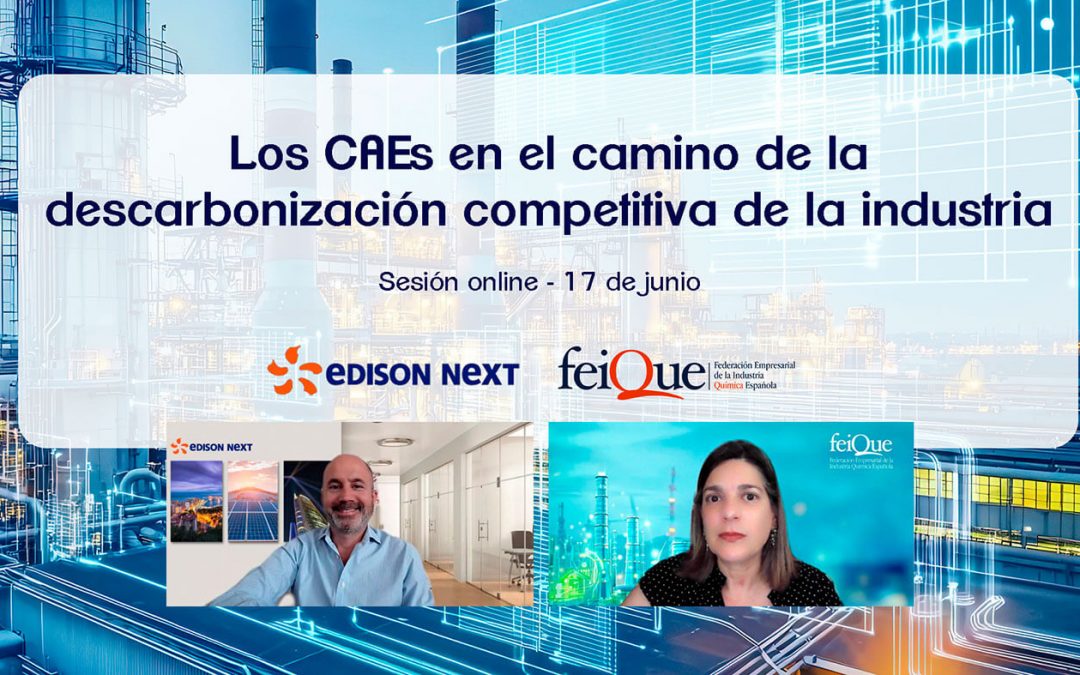
Last Tuesday, Edison Next participated as a Business Partner in the webinar organized by the Spanish Chemical Industry Business Federation (Feique). Under the title “CAEs on the path to competitive decarbonization in industry”, the session highlighted the key role of CAEs as a lever for advancing sustainability without compromising competitiveness.
The challenge of achieving net zero emissions cannot, or should not, be addressed with theoretical solutions or unaffordable investments. During his presentation, Luis Urrutia, Chief Business Development & Circular Economy Officer at Edison Next Spain, made it clear that the solution lies in applying efficient, realistic and viable technologies — but above all, doing so with an approach tailored to the reality of each industry and each client.
Edison Next Spain also explained that any decarbonization roadmap must be built on four fundamental pillars: energy efficiency, renewable energy, the circular economy and offsetting mechanisms.
Another key message that stood out during the session was the importance of moving away from viewing decarbonization as a cost, and instead approaching it in an organized way so that it becomes not an expense but a saving — in other words, competitive decarbonization.
To achieve this, at Edison Next Spain we champion a “risk-free” investment model that eliminates potential initial barriers. Under this approach, the client makes no upfront payment and begins benefiting from savings from day one, which Edison Next Spain guarantees. Furthermore, the benefit provided by CAEs is passed on directly and transparently to the initial CAPEX, reducing the return on investment timeframe and thus driving technologies that cut emissions and improve competitiveness.
During the webinar, we also presented real-life projects that demonstrate the positive results this model delivers. At an industrial plant, for example, the installation of a high-temperature heat pump is enabling the recovery of vapor heat to preheat drying air. This solution has generated savings of 5 GWh of natural gas and has made it possible to monetize more than €700,000 through CAEs.
We also shared the case of a client for whom, at one of their plants, we have installed a heat recovery system from a turbo blower to heat cleaning water. Thanks to this measure, the use of steam in this operation has been completely eliminated, and we have also succeeded in monetizing the energy savings through CAEs. A clear example of how innovation can translate into efficiency, sustainability and profitability from day one.
Thanks to our role as an accredited Delegated Subject, at Edison Next we not only execute the projects, but also handle the application, verification and monetization of Energy Saving Certificates, providing industrial companies with access to this incentive mechanism, always with full technical, regulatory and financial guarantees.
What this event made clear is that the chemical industry — and the industrial sector as a whole — has the capacity to advance towards deep decarbonization that would undoubtedly improve its competitiveness.
At Edison Next, we have spent years working to make this possible through tailored investment models, technical expertise across multiple sectors and tools such as Energy Saving Certificates (CAEs). Because when sustainability translates into tangible savings and value, the energy transition ceases to be a challenge and becomes a real competitive advantage.

Recent Comments