
Edison Next Spain, a subsidiary of the EDISON energy group and the French giant EDF, has been awarded a project promoted by the Regional Government of Andalusia to deploy energy self-consumption and sustainable mobility solutions in the province of Almería. The...
24 de April de 2026
Advanced active energy management strategies, a new way of understanding consumption
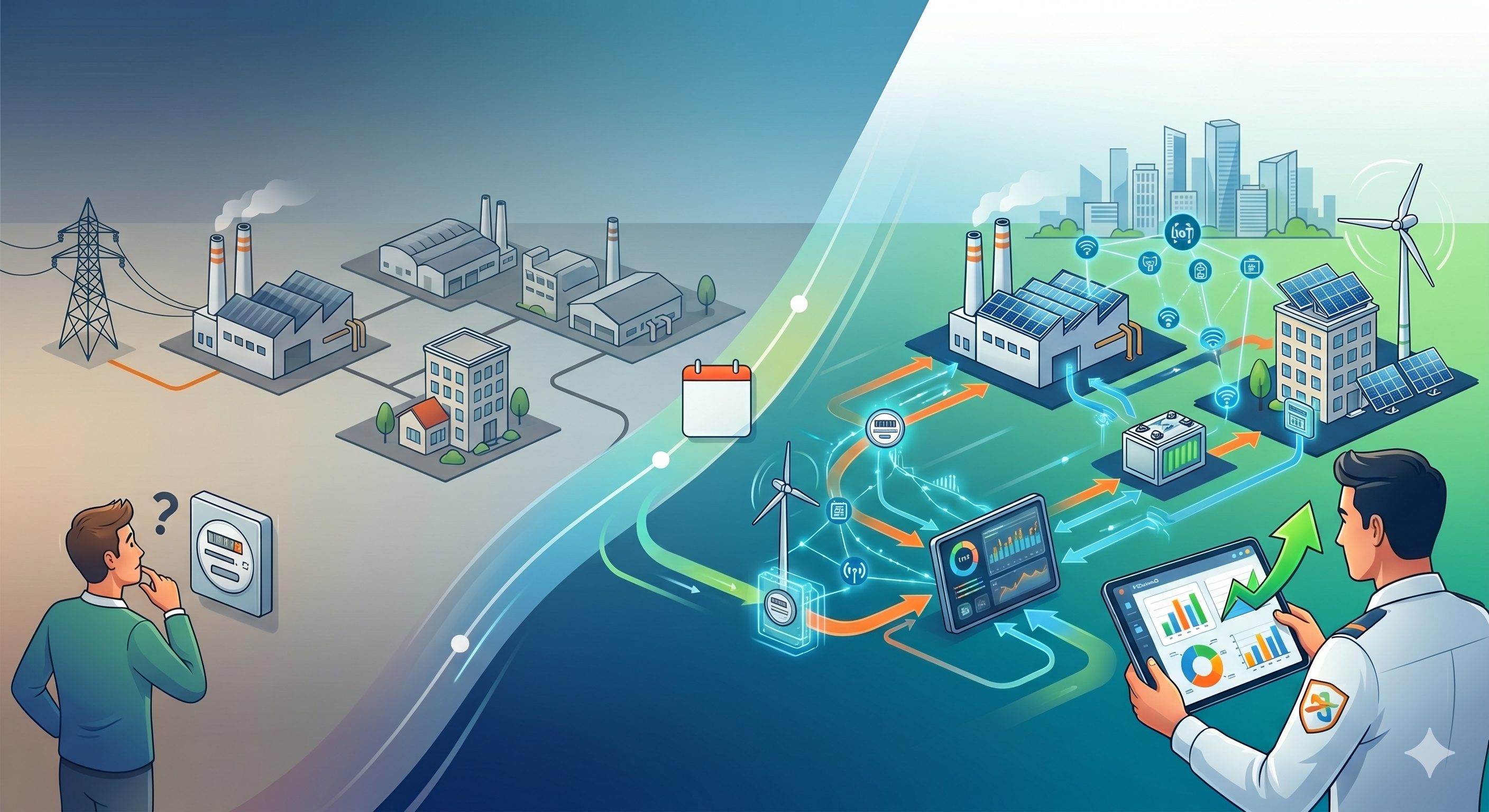
The electrical system is undergoing a phase of transformation in which the role of the consumer is changing. The growing penetration of renewable energies, together with a more volatile price scenario, has positioned flexibility as an essential element to guarantee the efficiency and stability of the system. Organizations now have the opportunity to evolve from a passive consumption model towards a more active approach, where energy management becomes a strategic lever.
Traditionally, self-consumption has been the main axis of this transformation. However, the current scenario demands going further. It is no longer just about generating energy and consuming it; the key lies in intelligently managing the relationship between generation, demand, and storage. This shift in focus is making it possible to optimize energy use based on variables such as price, availability, or operational needs.
In this new environment, the value of energy depends not only on its origin but also on the ability to decide when to use it, when to store it, or when to inject it into the system. To do this, it is essential to rely on energy management systems (EMS), storage solutions, and tools that allow for modulating consumption. The combination of these elements offers an active management model capable of aligning with the economic and operational objectives of each organization.
One of the most important strategies in this area is maximizing self-consumption, which seeks to make the most of locally generated energy. This involves adapting consumption patterns to periods of highest production and, when possible, storing surpluses for later use. In this way, exposure to the grid is reduced, and the impact of price volatility, which has been significantly affecting companies and industries in recent months, is limited.
Another key line of action is demand management to reduce power peaks. High peak demands can significantly increase costs associated with the power term or generate penalties. Through control and storage systems, it is possible to smooth the consumption curve, optimizing energy use during times of greatest need and thus reducing associated costs.
Price arbitrage constitutes another tool to consider in environments with hourly variability. This approach allows taking advantage of differences in electricity prices, storing energy during low-cost periods to use it when the price is higher. In this way, storage plays an active role in economic optimization.
Likewise, making consumption more flexible offers significant potential for improvement. The possibility of shifting certain loads such as HVAC, pumping, or non-critical industrial processes to more favorable hours allows for optimizing consumption without needing to undertake large investments. In many cases, this is one of the most cost-effective measures.
Of course, the regulatory framework is also evolving to support this model change. The incorporation of the independent aggregator figure, defined in Royal Decree 88/2026, reinforces the participation of demand in electricity markets. This allows consumers, through their energy assets, to offer flexibility services to the system, opening up new value opportunities.
The true potential offered by this new scenario lies not in the isolated application of these strategies, but in their combination. Advanced energy management systems make it possible to coordinate generation, storage, and demand based on multiple variables, optimizing the behavior of the installation at all times and maximizing overall benefit.
Ultimately, active energy management represents a paradigm shift that goes beyond the incorporation of technology. It requires a comprehensive approach that combines analysis, planning, and continuous operation. The ability to integrate these elements and adapt them to changing environmental conditions will determine whether or not organizations succeed in transforming energy into a lever for efficiency, competitiveness, and long-term sustainability.
At Edison Next Spain, we work in this area, accompanying organizations in the definition and implementation of advanced energy management strategies, integrating technologies and operational models that allow harnessing the full potential of flexibility in the new energy system.
Contact Us
Edison
Next
Information on the processing of your personal data in accordance with the provisions of the General Regulation (EU) 2016/679, on data protection (RGPD) and the L.O. 3/2018, on data protection and guarantee of digital rights (LOPDGDD).
Company Name: EDISON NEXT SPAIN, S.L.U.
Purpose: To respond to your queries and requests.
Legitimacy: Consent expressed by the sender when sending the data via the form provided for this sole purpose.
Rights: You may at any time exercise your right to access, rectification, deletion and portability of the personal data processed by Edison Next, as well as to oppose and limit such processing, by sending a signed request with proof of identity to privacidad@edison.es
Additional information: You can read more detailed information and other additional information in our privacy policy: www.edisonnext.es
