
Edison Next Spain, a subsidiary of the EDISON energy group and the French giant EDF, has been awarded a project promoted by the Regional Government of Andalusia to deploy energy self-consumption and sustainable mobility solutions in the province of Almería. The...
19 de December de 2025
Challenges and opportunities of biomethane in Spain for 2030
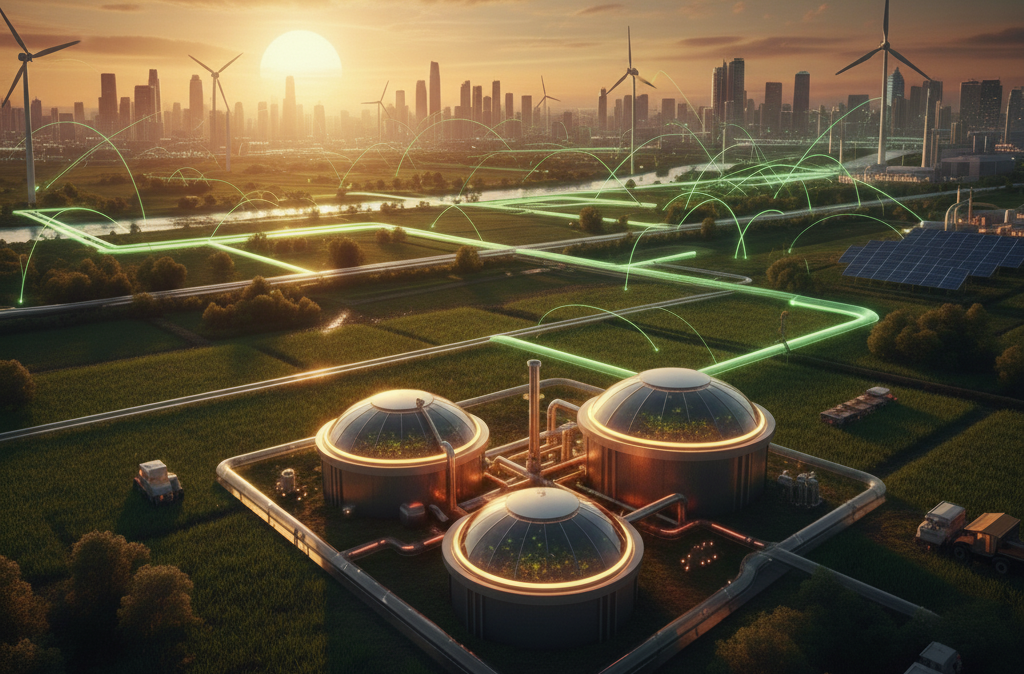
The energy transition is advancing at different speeds depending on the sector, technology, and territory. While electrification is becoming one of the main pathways for decarbonization, there are areas where replacing gas or fossil fuels remains a particularly complex challenge. For these cases, biomethane has become one of the most solid and realistic solutions to accelerate their decarbonization without compromising competitiveness.
Looking ahead to 2030, biomethane is no longer an emerging alternative but has become a central piece of the new energy model. It is not only a renewable source but also a tool capable of connecting sustainability, circular economy, and territorial development.
Spain has particularly favorable conditions for the development of biomethane. The high and easy access we have to agricultural, livestock, industrial, and urban waste, together with an extensive existing gas network, places our country in a privileged position to promote this renewable solution.
The energy use of this waste would allow us to transform an environmental problem into a local, manageable, and stable energy resource. Furthermore, biomethane can be injected directly into our gas network, used in industrial processes, heating and cooling, or mobility, facilitating its integration without the need for major changes to existing infrastructure.
However, despite this potential, the deployment of biomethane in Spain is still in an initial phase compared to our European neighbors. The challenge lies not so much in the technology, which is already mature, but in accelerating its implementation and improving society’s awareness regarding this energy source.
The development of biomethane in Spain faces several challenges that we will all have to address in the coming years. One of the main ones is the regulatory framework. Regulatory stability, administrative simplification, and agility in project processing will undoubtedly be determining factors for attracting investment and scaling this solution.
From an operational point of view, the integration of plants, efficient waste management, logistics, and process optimization require experience and a comprehensive vision. Furthermore, social acceptance and collaboration with the territories where projects are implemented will be a decisive element to guarantee their success and their contribution to local development.
Beyond the challenges, biomethane opens up a wide range of opportunities. For industry, it represents an immediate way to reduce emissions in thermal processes where electrification is not always viable, without sacrificing operational continuity or competitiveness.
From a territorial perspective, biomethane drives the circular economy, fosters rural development, generates local employment, and contributes to more sustainable waste management. Each project becomes an engine of shared value, where environmental sustainability, economic impact, and territorial cohesion go hand in hand.
Furthermore, biomethane would play a very important role in reducing energy dependence on foreign countries, strengthening supply security and betting on a more decentralized national energy model.
In this scenario, companies no longer only need technology providers, but require energy partners capable of supporting them throughout the entire process.
Experience in the circular economy, efficient waste management, and the integration of renewable solutions have become key factors to ensure that biomethane projects are sustainable from a technical, economic, and environmental point of view. Collaboration between public administrations, private companies, and local agents is, without a doubt, one of the main accelerators of its deployment.
Looking ahead to the coming years, biomethane will be a necessary complement to electrification and other renewable sources. Its ability to offer an immediate, scalable solution aligned with the principles of the circular economy makes it one of the great levers of the energy transition in Spain.
The real challenge is no longer technological, but strategic. Deciding how, where, and with whom to develop projects will make the difference, and will allow us to move forward, or not, towards the future by harnessing all the potential that biomethane can bring to the energy system.
At Edison Next Spain, we work with this long-term vision, supporting companies and territories in the development of sustainable energy solutions that combine efficiency, circularity, and competitiveness. This commitment is also reflected in our strategic decisions, such as the recent purchase from Iberdrola of cogeneration assets for the treatment of slurry and new biomethane projects in Spain, which reinforce our commitment to renewable gases and the circular economy.
Contact Us
Edison
Next
Information on the processing of your personal data in accordance with the provisions of the General Regulation (EU) 2016/679, on data protection (RGPD) and the L.O. 3/2018, on data protection and guarantee of digital rights (LOPDGDD).
Company Name: EDISON NEXT SPAIN, S.L.U.
Purpose: To respond to your queries and requests.
Legitimacy: Consent expressed by the sender when sending the data via the form provided for this sole purpose.
Rights: You may at any time exercise your right to access, rectification, deletion and portability of the personal data processed by Edison Next, as well as to oppose and limit such processing, by sending a signed request with proof of identity to privacidad@edison.es
Additional information: You can read more detailed information and other additional information in our privacy policy: www.edisonnext.es
