
Edison Next Spain, a subsidiary of the EDISON energy group and the French giant EDF, has been awarded a project promoted by the Regional Government of Andalusia to deploy energy self-consumption and sustainable mobility solutions in the province of Almería. The...
23 de January de 2026
The beginning of the year, a decisive moment for the tourism sector
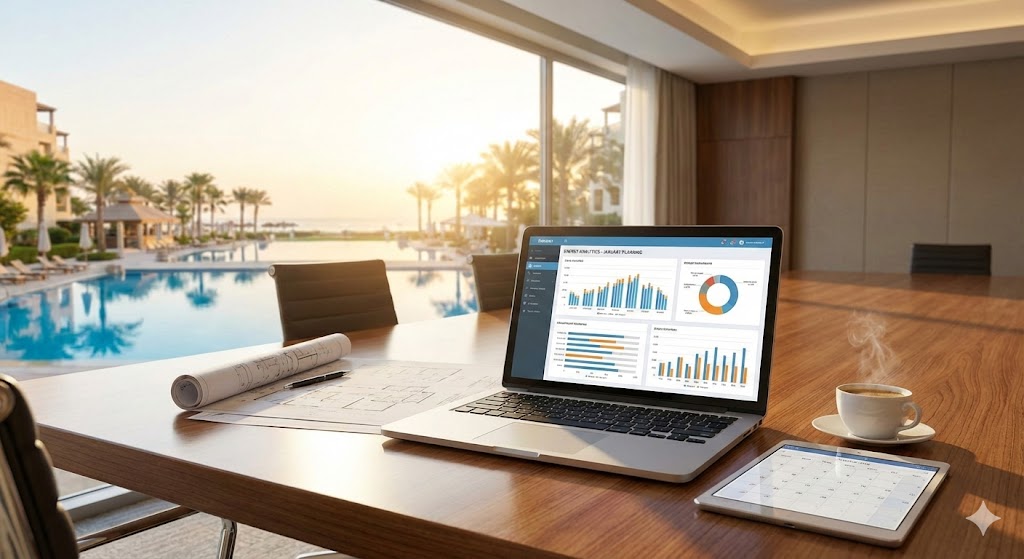
The tourism sector operates in an especially demanding environment from an energy perspective. Hotels, resorts, tourist apartments, and holiday complexes must guarantee comfort, uninterrupted service, and security, while simultaneously managing intensive and variable consumption.
Although it may not seem so, the beginning of the year is one of the most advisable times to tackle this challenge. After the end of the financial year and with the high season still ahead, companies in the sector often take advantage of this period to analyze the real performance of their facilities and define how they want to manage energy for the rest of the year.
One of the lessons learned each year, which we increasingly observe with more companies in the sector, is that energy can no longer be managed based on estimates or one-off decisions. The tourism sector needs increasingly precise data that allows it to understand how its facilities behave depending on occupancy, weather conditions, or the different uses of spaces.
The start of the year allows for reviewing historical consumption, identifying inefficiencies, and detecting deviations that, during periods of peak activity, often go unnoticed. This analysis phase is necessary to prioritize actions, correctly size investments, and avoid oversized solutions or those poorly aligned with the actual operational reality of the business.
In the tourism sector, moreover, any energy action must start from a clear premise: efficiency cannot come at the expense of comfort. Air conditioning, lighting, domestic hot water, or ventilation are elements directly linked to the guest experience and, therefore, to the perception of the establishment.
For this reason, the most effective energy solutions are those that act progressively and are integrated into daily operations. The modernization of HVAC and DHW systems, the improvement of thermal solutions, the use of efficient lighting, or the incorporation of regulation and control systems allow for reducing consumption and costs without affecting service quality. When well implemented, these solutions also contribute to improving the stability of the facilities and the comfort of the spaces.
On the other hand, variability is one of the most determining factors in the energy consumption of the tourism sector. Changes in occupancy levels, seasonality, or specific events can cause significant fluctuations in the energy demand of buildings.
In this context, energy digitalization allows evolving from reactive management to a more anticipatory one. Monitoring solutions, energy management systems, and centralized control tools provide a global view of facility operations, help detect deviations early, and allow optimizing energy use based on actual operating conditions.
This greater control translates into greater reliability of the facilities. Fewer incidents, greater service continuity, and a better capacity to respond to unforeseen situations help guarantee the correct functioning of the buildings, especially during periods of highest activity.
More and more companies in the sector are becoming aware that energy not only impacts economic costs but also business continuity. An electrical incident, a failure in the air conditioning, or a supply interruption during a period of high occupancy can have direct consequences on customer satisfaction and the establishment’s reputation.
Therefore, energy reliability has become a strategic aspect. Having properly maintained facilities, efficient management systems, and preventive maintenance plans is key to ensuring that energy supports the business activity at all times.
This operational context is compounded by an increasingly demanding regulatory environment, which drives buildings in the tertiary sector to advance in energy efficiency, digitalization, and emission reduction. Anticipating these changes allows tourism sector companies to plan their investments with greater judgment, reduce future risks, and move in an orderly manner towards more sustainable energy models.
At Edison Next Spain, we have been working alongside the tourism sector for years with this long-term perspective. We support hotels and chains operating in our country in the analysis and deployment of energy solutions aimed at improving efficiency, strengthening operational reliability, and advancing sustainability without compromising competitiveness.
This goal of support has led us, this week, to be present at FITUR, one of the main meeting points for the tourism sector internationally. A key space to listen to the sector, share its vision with collaborators, and maintain direct contact with hotels, chains, and tour operators already immersed in their planning processes for the new season.
Being at FITUR has allowed us to take the pulse of the sector’s real priorities, understand how their energy needs evolve, and continue building relationships that translate into concrete projects and solutions aligned with the actual operations of each business. And it is that, in a sector where the customer experience is a determining factor, energy management has become a key element.
Contact Us
Edison
Next
Information on the processing of your personal data in accordance with the provisions of the General Regulation (EU) 2016/679, on data protection (RGPD) and the L.O. 3/2018, on data protection and guarantee of digital rights (LOPDGDD).
Company Name: EDISON NEXT SPAIN, S.L.U.
Purpose: To respond to your queries and requests.
Legitimacy: Consent expressed by the sender when sending the data via the form provided for this sole purpose.
Rights: You may at any time exercise your right to access, rectification, deletion and portability of the personal data processed by Edison Next, as well as to oppose and limit such processing, by sending a signed request with proof of identity to privacidad@edison.es
Additional information: You can read more detailed information and other additional information in our privacy policy: www.edisonnext.es
