
Edison Next Spain, a subsidiary of the EDISON energy group and the French giant EDF, has been awarded a project promoted by the Regional Government of Andalusia to deploy energy self-consumption and sustainable mobility solutions in the province of Almería. The...
8 de May de 2026
Categorías: Blog
Solar self-consumption and electric mobility: keys to promoting sustainability in natural spaces
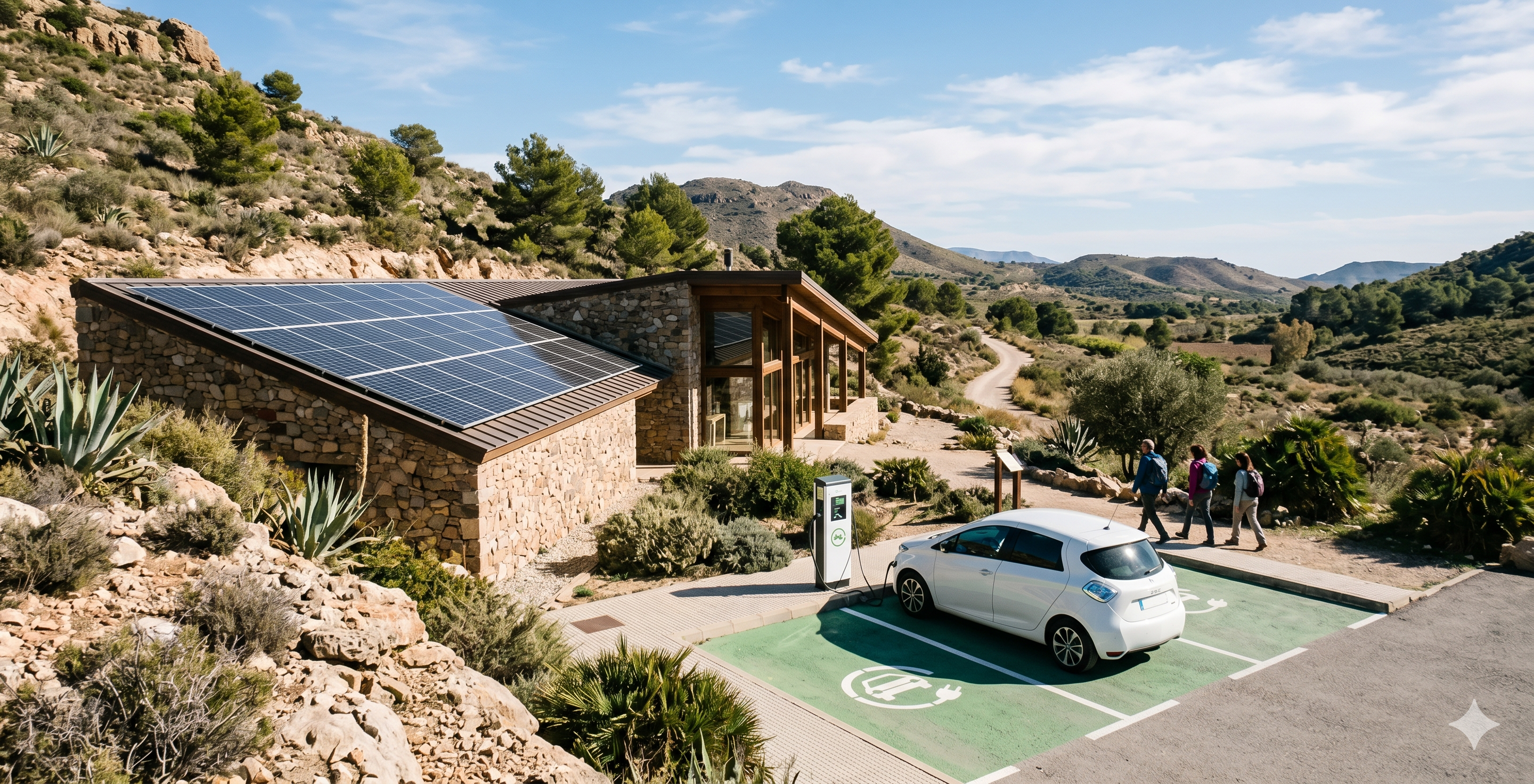
Natural spaces play a fundamental role in biodiversity conservation, environmental education, and the sustainable development of the territory. Every year, thousands of people visit interpretation centers, recreational areas, and protected natural enclaves, turning these infrastructures into strategic points for promoting more responsible and efficient energy models.
Sustainability in this type of environment is especially important, as their activity must coexist with landscape protection, ecosystem preservation, and the reduction of environmental impact. Furthermore, many of these spaces are located in areas far from large urban centers, where resource optimization and energy efficiency take on even greater value.
In this context, solar self-consumption and electric mobility are becoming key solutions for advancing towards energy self-sufficiency and the decarbonization of infrastructures linked to biodiversity conservation.
The installation of photovoltaic plants makes it possible to generate clean and renewable energy to cover part of the energy needs of these spaces, while the incorporation of electric charging points promotes more sustainable mobility aligned with energy transition goals.
An example of this transformation is the project that Edison Next is developing in the province of Almería, promoted by the Andalusian Regional Government and financed through European Next Generation EU funds. The initiative includes the implementation of solar self-consumption and electric vehicle charging solutions in 19 natural spaces, including visitor centers, recreational areas, and enclaves linked to the conservation of natural heritage.
Thanks to these actions, the facilities will be able to generate part of their own energy autonomously, reduce emissions, and improve their energy efficiency. Additionally, the charging points will be powered by the energy generated by the photovoltaic installations themselves, promoting a more efficient and integrated energy model.
The integration of sustainable technologies in this type of environment demonstrates that the energy transition can also become a tool for environmental protection. Betting on renewable solutions in natural spaces not only helps reduce environmental impact but also helps raise public awareness about the importance of building a more sustainable future.
At Edison Next, we work to support administrations and public entities in developing projects that combine energy efficiency, renewable energies, and sustainable mobility, contributing to creating more resilient, responsible, and environmentally respectful environments.
Contact Us
Edison
Next
Information on the processing of your personal data in accordance with the provisions of the General Regulation (EU) 2016/679, on data protection (RGPD) and the L.O. 3/2018, on data protection and guarantee of digital rights (LOPDGDD).
Company Name: EDISON NEXT SPAIN, S.L.U.
Purpose: To respond to your queries and requests.
Legitimacy: Consent expressed by the sender when sending the data via the form provided for this sole purpose.
Rights: You may at any time exercise your right to access, rectification, deletion and portability of the personal data processed by Edison Next, as well as to oppose and limit such processing, by sending a signed request with proof of identity to privacidad@edison.es
Additional information: You can read more detailed information and other additional information in our privacy policy: www.edisonnext.es
