
Edison Next Spain, a subsidiary of the EDISON energy group and the French giant EDF, has been awarded a project promoted by the Regional Government of Andalusia to deploy energy self-consumption and sustainable mobility solutions in the province of Almería. The...
2 de January de 2026
Categorías: Blog
The trends that will define the future of decarbonization in 2026
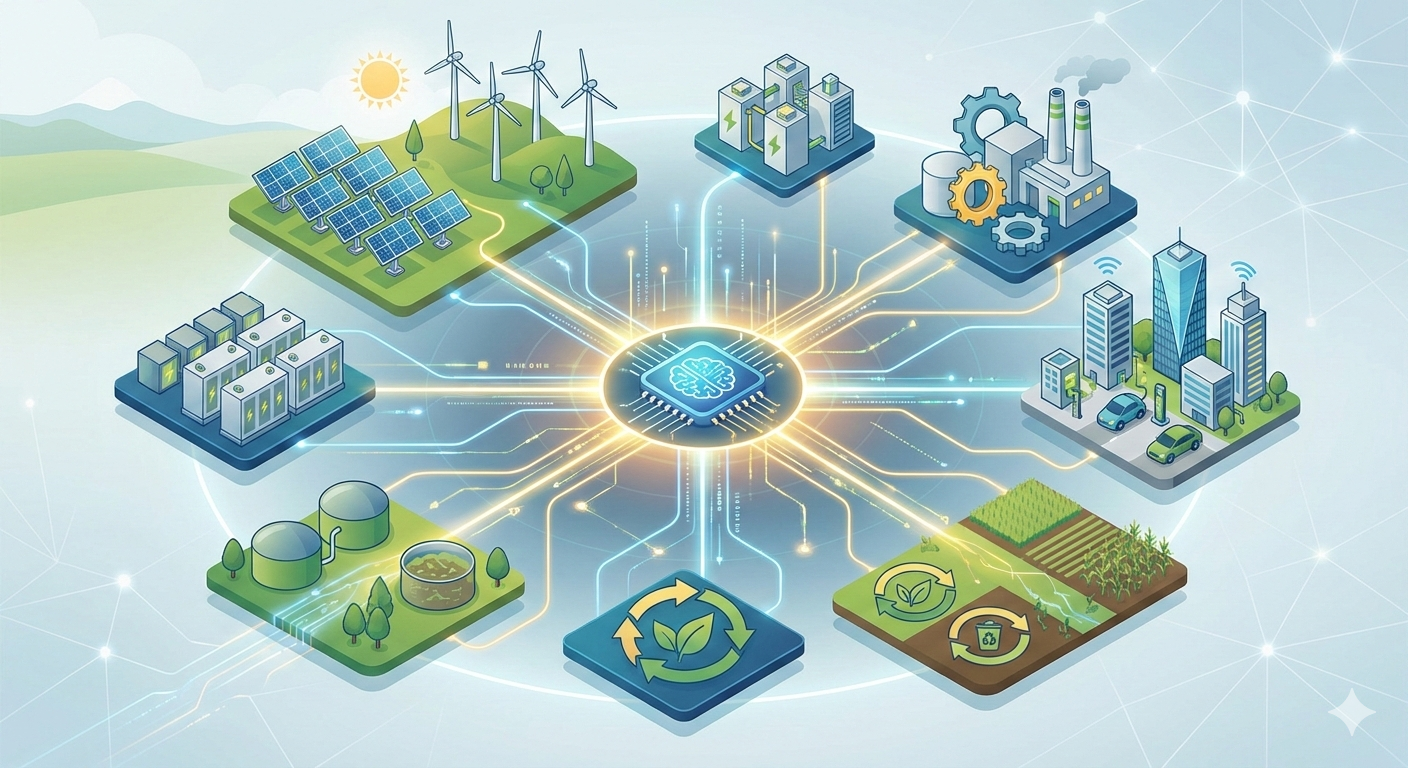
In 2026, decarbonization enters a new phase. It is no longer enough to simply deploy technology or meet regulatory targets, as we have already reached a stage where we need to integrate energy solutions intelligently, efficiently, and aligned with the economic reality of companies and territories. From our experience supporting projects throughout Spain, the coming year will be marked by a more mature and strategic vision of the energy transition.
Renewable generation will continue to grow, but the focus will increasingly shift from installing new capacity to how that energy is integrated into existing systems. The real challenge will be to maximize its actual use through models that combine self-consumption, storage, and advanced management.
In many industrial, urban, and tertiary sector projects, we are already seeing that without intelligent management, a significant portion of renewable energy’s potential is lost. Therefore, integration with control, monitoring, and optimization systems will be one of the major drivers of decarbonization in 2026.
In this scenario, energy digitalization will cease to be a support element and become a central axis. BMS systems, advanced analytics, and artificial intelligence will make it possible to anticipate consumption, detect inefficiencies, and make decisions based on real data. Thanks to this evolution, at Edison Next Spain we are already transforming hospitals, public buildings, industrial plants, and lighting networks, where intelligent management not only reduces emissions but also improves comfort, safety, and operational efficiency. In the new landscape, energy that is neither measured nor managed will cease to be competitive.
Electrification will continue to advance strongly, especially in areas such as HVAC, mobility, and low-temperature thermal processes. However, 2026 will consolidate the idea that electrifying without planning can generate cost overruns and inefficiencies.
The most robust projects will be those that analyze the complete energy cycle, considering actual demand, existing infrastructure, grid impact, total cost, and return on investment. The technology is already ready; now the challenge is to design well-dimensioned and economically sustainable electrification strategies.
At the same time, the decarbonization of sectors that are hardest to electrify will continue to rely on solutions such as biomethane and circular economy models. In 2026, renewable gases will gain prominence not only for their environmental contribution but also for their ability to valorize waste, generate local energy, and reduce dependence on fossil fuels. The development of biomethane projects, efficient cogeneration, and energy recovery from by-products will finally be consolidated as a realistic and necessary path to advance the energy transition in Spain.
All of this is framed within an increasingly evident fundamental shift: sustainability is ceasing to be perceived as a regulatory obligation and is becoming a competitive advantage. Companies and administrations that integrate energy into their strategy, rather than treating it as an isolated project, are better prepared to attract investment, talent, and growth opportunities.
It is no coincidence that more and more organizations are seeking energy partners capable of supporting them long-term, from diagnosis to operation and continuous improvement. Taken together, these trends point to a decarbonization that is more cross-cutting, more demanding, and more connected to the business, industrial, and social reality of our country.
That is why, at Edison Next Spain, we face this scenario with a long-term vision, supporting companies and territories in developing energy solutions that combine efficiency, renewables, circular economy, and intelligent management. Because moving towards 2026 will not only be about reducing emissions, but above all, about building a more competitive energy model aligned with the real needs of Spanish society.
Contact Us
Edison
Next
Information on the processing of your personal data in accordance with the provisions of the General Regulation (EU) 2016/679, on data protection (RGPD) and the L.O. 3/2018, on data protection and guarantee of digital rights (LOPDGDD).
Company Name: EDISON NEXT SPAIN, S.L.U.
Purpose: To respond to your queries and requests.
Legitimacy: Consent expressed by the sender when sending the data via the form provided for this sole purpose.
Rights: You may at any time exercise your right to access, rectification, deletion and portability of the personal data processed by Edison Next, as well as to oppose and limit such processing, by sending a signed request with proof of identity to privacidad@edison.es
Additional information: You can read more detailed information and other additional information in our privacy policy: www.edisonnext.es
