
Edison Next Spain, a subsidiary of the EDISON energy group and the French giant EDF, has been awarded a project promoted by the Regional Government of Andalusia to deploy energy self-consumption and sustainable mobility solutions in the province of Almería. The...
21 de October de 2025
Categorías: Press
BlueSea Hotels bets on sustainability and begins its decarbonization with Edison Next.
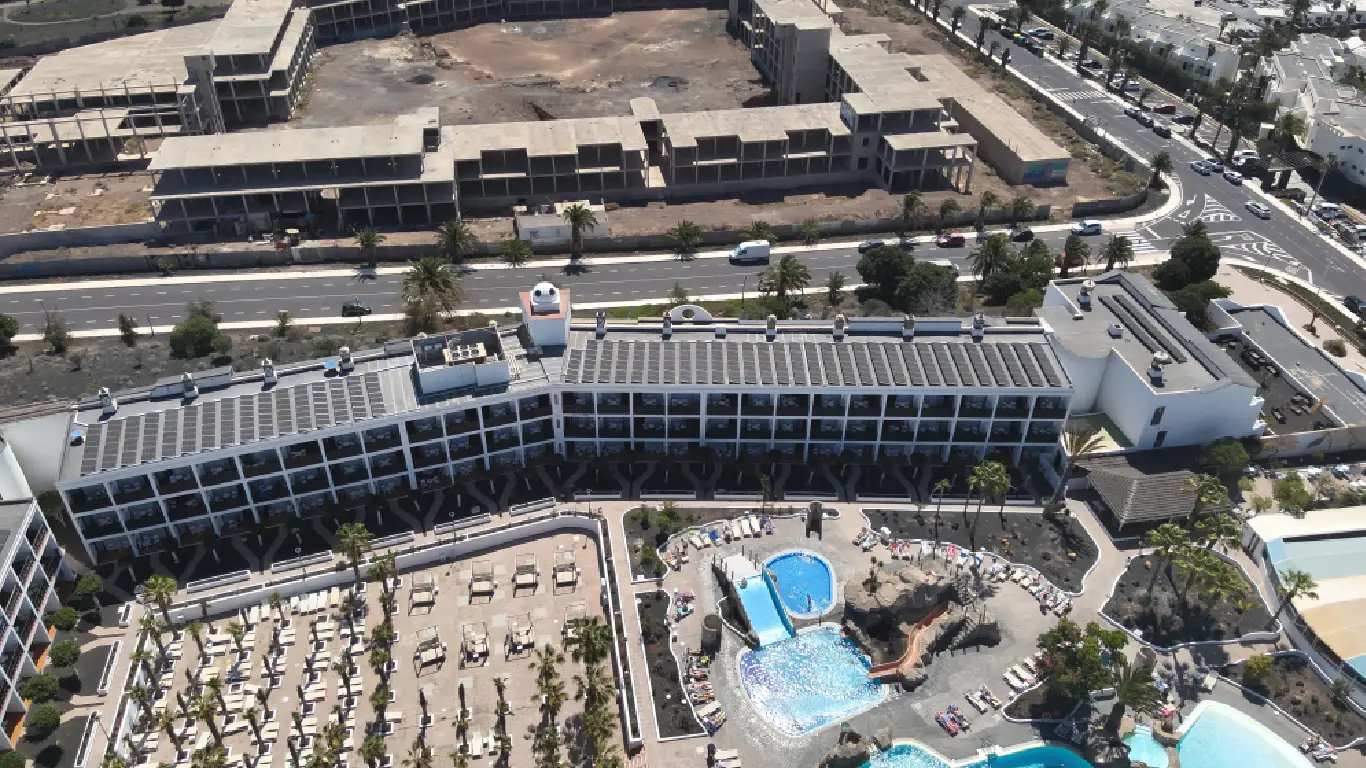
The BlueSea Hotels chain has launched its decarbonization strategy with the support of Edison Next Spain, by commissioning the first photovoltaic self-consumption plant at its Hotel Costa Bastián (Lanzarote). This is the first project in an ambitious plan that is expected to extend to five other hotels of the company in Spain.
The energy solutions company Edison Next has installed 426 solar modules at the Lanzarote hotel, totaling a capacity of 191.70 kWp and covering 855 m² of roof space. Thanks to this infrastructure, the hotel will generate 314.7 MWh of clean energy per year, equivalent to the average annual consumption of more than 90 homes. Through this action, the hotel will reduce its energy costs and strengthen its independence from volatile energy prices.
The environmental impact will be equally notable. This project will prevent the emission of 315 tons of CO₂ per year compared to using coal, or 126.5 tons compared to natural gas, according to IDAE data. This step places BlueSea Hotels on the path of European climate commitments and accelerates the transformation of the island’s tourism towards a more responsible and sustainable model, increasingly demanded by customers and society.
This project represents the first step in a broader strategy by BlueSea Hotels to progressively decarbonize all its hotels in Spain. The company has already planned similar actions at five other establishments located in destinations in the Canary Islands and the Balearic Islands, which will allow it to achieve a combined renewable production of 1,060.6 MWh per year.
With this, the hotel chain expects to prevent the emission of 1,044 tons of CO₂ annually. This project has consolidated BlueSea Hotels as a player committed to the energy transition of the tourism sector and strengthens its ability to respond to the growing demand for a more sustainable vacation model from customers, administrations, and society in general.
According to the latest Energy Insight report, around 74% of travelers in Spain consider it essential to minimize their environmental footprint on their vacations, and 40% state that the ecological impact directly influences their motivation to choose a destination or accommodation. Furthermore, more and more Spaniards argue that tourism is an engine that generates a positive impact in their area, provided it is carried out responsibly.
That is why examples like that of BlueSea Hotels are so relevant. They demonstrate that sustainability is no longer an aspirational value but becomes a real competitive advantage. Other hotel chains have an opportunity to align with these new market expectations by adopting similar measures that contribute to caring for the environment and the surroundings where they operate.
“With this agreement, BlueSea Hotels will demonstrate that sustainability has become a strategic pillar for the future of the hotel sector. Our goal is to help them move towards a more efficient and environmentally friendly model, without sacrificing their quality or competitiveness,” stated Edison Next Spain.
Through actions like this, more and more tourism companies are sending the message to the sector that the future tourism competitiveness will be measured in sustainability, also arguing that tourism can be an economic engine without neglecting the care of the environment.
Contact Us
Edison
Next
Information on the processing of your personal data in accordance with the provisions of the General Regulation (EU) 2016/679, on data protection (RGPD) and the L.O. 3/2018, on data protection and guarantee of digital rights (LOPDGDD).
Company Name: EDISON NEXT SPAIN, S.L.U.
Purpose: To respond to your queries and requests.
Legitimacy: Consent expressed by the sender when sending the data via the form provided for this sole purpose.
Rights: You may at any time exercise your right to access, rectification, deletion and portability of the personal data processed by Edison Next, as well as to oppose and limit such processing, by sending a signed request with proof of identity to privacidad@edison.es
Additional information: You can read more detailed information and other additional information in our privacy policy: www.edisonnext.es
