
Natural spaces play a fundamental role in biodiversity conservation, environmental education, and the sustainable development of the territory. Every year, thousands of people visit interpretation centers, recreational areas, and protected natural enclaves, turning...
27 de June de 2025
Categorías: Blog
Spain takes a key step towards the energy transition with the new Royal Decree to strengthen the electrical system.
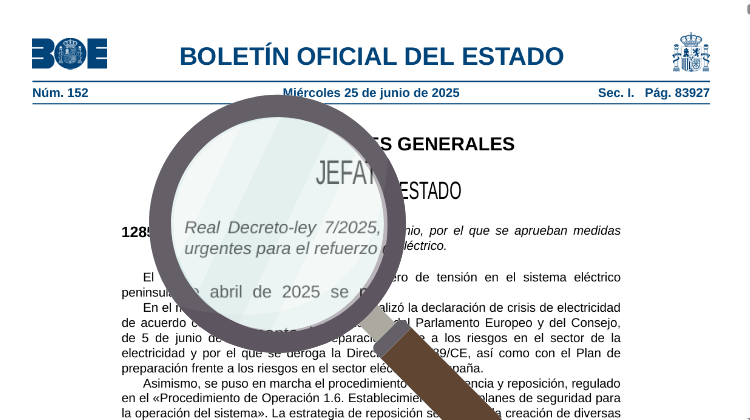
At Edison Next, we are clear that after the blackout on April 28, we must take measures, and we applaud Royal Decree-Law 7/2025, which strengthens system supervision, promotes storage and flexibility, and encourages electrification.
The recent approval responds decisively to the tensions experienced in the electricity system and introduces specific measures to facilitate the integration of technologies such as storage, self-consumption, electrification, and flexibility.
The new decree gives a definitive boost to energy storage by declaring it of public utility when connected to the grid, which facilitates procedures such as expropriations and easements. Furthermore, these measures will reduce processing times and eliminate environmental assessments in the case of projects hybridized with renewables, while simultaneously prioritizing their evacuation to the electricity system. Access and connection permits are also being made more flexible, and the possibility of obtaining a provisional authorization for testing before the final one is granted is contemplated, which will greatly speed up project execution.
At Edison Next, we see these changes as a great opportunity to deploy more storage solutions, both in standalone installations and hybrid projects. This is something we were already developing with some of our industrial and public clients, but it will undoubtedly become one of our main lines of action in the coming months.
This Decree-Law also brings important developments in the area of self-consumption. The figure of the “Self-Consumption Manager” is created, allowing third parties to represent consumers in such schemes, facilitating the management of collective installations. Self-consumption modalities are also expanded, and the permitted distance between generation and consumption for installations up to 5 MW is increased to 5 kilometers, enabling the development of a large number of new projects.
The decree also reinforces the role of storage and other non-fossil flexibility sources in energy planning. At the same time, processing times for repowering projects of up to 25% of the original capacity are halved, something we believe is essential for modernizing existing infrastructure and gaining efficiency without starting from scratch. At Edison Next, we believe these measures will serve to make the definitive leap in the digitalization and optimization of the electricity system.
The regulation also considers the need to electrify energy consumption, especially in industrial and energy-intensive sectors. To this end, the support mechanism for the electro-intensive industry is reactivated, with an 80% reduction in electricity tolls, procedures for electric vehicle charging installations are simplified, and the use of transmission networks to supply final consumption with distribution functions is allowed. These measures not only reduce barriers but also fit
perfectly with our activity in the field of electric mobility and industrial energy efficiency.
Finally, the decree reinforces legal certainty in the sector, something we at Edison Next Spain had been requesting for some time. The concept of installed capacity is redefined to avoid ambiguities, and authorization procedures are clarified, allowing promoters and operators like Edison Next to move forward with greater confidence in our investments.
In short, Royal Decree-Law 7/2025 lays the foundations for a new and necessary framework that is more agile, coherent, and oriented towards the rapid deployment of fundamental solutions for the energy transition.
At Edison Next, we continue and will continue working so that these new opportunities that arise ultimately become real projects that add value to our clients and the system as a whole. Our commitment to making efficiency, flexibility, and sustainability a tangible reality across the entire business and public fabric remains as firm as ever. Because only in this way can we move towards a cleaner and more competitive energy model.
Contact Us
Edison
Next
Information on the processing of your personal data in accordance with the provisions of the General Regulation (EU) 2016/679, on data protection (RGPD) and the L.O. 3/2018, on data protection and guarantee of digital rights (LOPDGDD).
Company Name: EDISON NEXT SPAIN, S.L.U.
Purpose: To respond to your queries and requests.
Legitimacy: Consent expressed by the sender when sending the data via the form provided for this sole purpose.
Rights: You may at any time exercise your right to access, rectification, deletion and portability of the personal data processed by Edison Next, as well as to oppose and limit such processing, by sending a signed request with proof of identity to privacidad@edison.es
Additional information: You can read more detailed information and other additional information in our privacy policy: www.edisonnext.es
