
Natural spaces play a fundamental role in biodiversity conservation, environmental education, and the sustainable development of the territory. Every year, thousands of people visit interpretation centers, recreational areas, and protected natural enclaves, turning...
27 de February de 2026
Categorías: Blog
Demand flexibility, the new competitive advantage of the Spanish electricity system
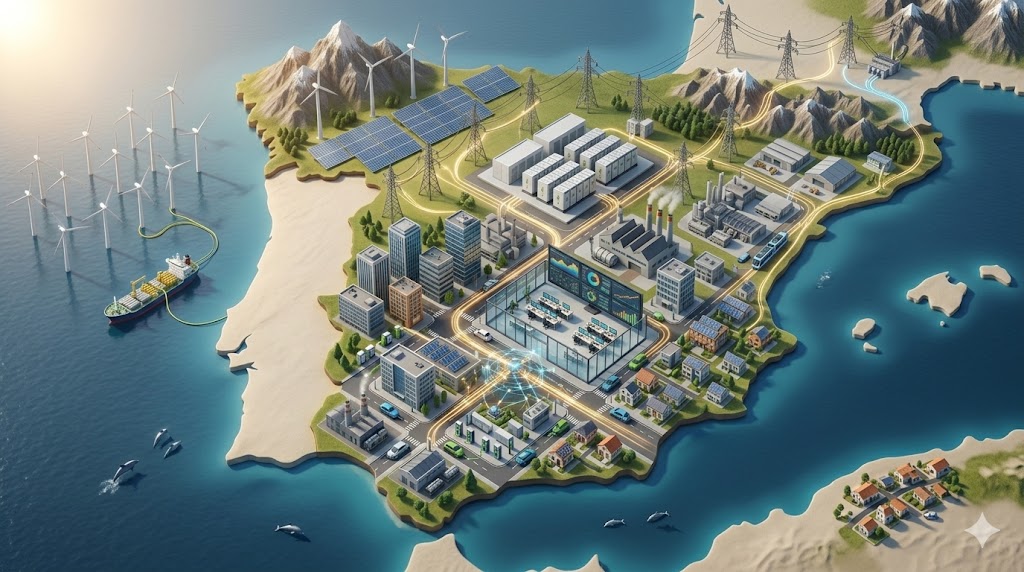
Spain is heading towards an electricity system with a massive presence of renewable energies. The objective defined in the National Integrated Energy and Climate Plan (PNIEC 2023-2030) of achieving 81% renewable generation by 2030 reflects an imminent and unprecedented structural change.
However, this transformation still coexists with an electricity market designed for dispatchable technologies, that is, electricity generation sources that can increase or decrease their output on demand. Therefore, it is now essential to evolve towards a system that integrates flexibility, facilitating the incorporation of renewable energy into the system and ensuring the quality and security of supply.
This system inefficiency represents an untapped business opportunity. The ability to modulate energy consumption has ceased to be a simple efficiency measure and has become a monetizable asset, capable of generating additional revenue. Nevertheless, this potential can only be realized if the market evolves towards a model that fully integrates flexibility into the operation of the electricity system. For this to happen, and for demand-side flexibility to play this new role in the system, action is needed on three levers.
First, regulatory unblocking and market access for distributed resources on equal terms with traditional generation are necessary. The modification introduced in 2026 for the Active Demand Response Service (SRAD) eliminates, for the first time, the requirement to have a minimum of 1 MW per supply point, allowing small installations to participate in the market through the aggregation of 0.1 MW of flexible power.
On the other hand, Royal Decree 88/2026 defines the figure of the Independent Demand Aggregator, a fundamental step since, until now, consumers could only participate in the market through retailers.
Second, technological enablement and digitalization are essential to support the regulatory framework. Internal process optimization requires the deployment of advanced Energy Management Systems (EMS) in the industrial sector and Building Management Systems (BMS) in the tertiary sector, capable of integrating asset control and prediction using Artificial Intelligence techniques.
Third, economic signals and the development of local flexibility markets are crucial to drive the participation of all consumers. To ensure the viability of the model, the aggregator must be able to participate in all balancing services, as its presence helps reduce the system’s operational costs and generates continuous price signals that make consumer participation profitable. Furthermore, mechanisms need to be developed to allow distributors to manage congestion in their networks.
With the latest advances, Spain is taking the first steps so that demand-side flexibility moves from theory to the bottom line. The removal of technical barriers and the legal enablement of the Independent Aggregator will allow consumers to monetize the adaptability of their production processes, also contributing to the stability of an electricity system driven by renewable energies.
At Edison Next, we are more prepared than ever to continue supporting companies in this transition, integrating regulatory analysis, advanced technological solutions, and energy management models that allow flexibility to be monetized in a structured and secure way. Because in an electricity system undergoing full transformation, the capacity to adapt is already one of the main differentiating factors for competitiveness.
Contact Us
Edison
Next
Information on the processing of your personal data in accordance with the provisions of the General Regulation (EU) 2016/679, on data protection (RGPD) and the L.O. 3/2018, on data protection and guarantee of digital rights (LOPDGDD).
Company Name: EDISON NEXT SPAIN, S.L.U.
Purpose: To respond to your queries and requests.
Legitimacy: Consent expressed by the sender when sending the data via the form provided for this sole purpose.
Rights: You may at any time exercise your right to access, rectification, deletion and portability of the personal data processed by Edison Next, as well as to oppose and limit such processing, by sending a signed request with proof of identity to privacidad@edison.es
Additional information: You can read more detailed information and other additional information in our privacy policy: www.edisonnext.es
