
Natural spaces play a fundamental role in biodiversity conservation, environmental education, and the sustainable development of the territory. Every year, thousands of people visit interpretation centers, recreational areas, and protected natural enclaves, turning...
13 de March de 2026
Categorías: Blog
Comprehensive energy management, a long-term oriented model
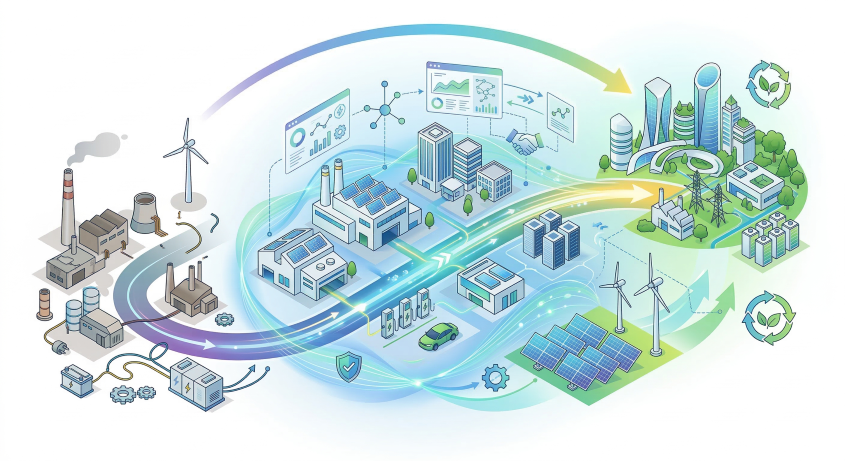
For years, energy management in many organizations was approached from a specific and reactive logic, that is: replacing obsolete equipment, reducing a specific consumption, or taking advantage of an available subsidy. However, the current energy context has completely transformed this vision. Energy has ceased to be a mere operational input and has become a structural variable that directly impacts the competitiveness, resilience, and sustainability of any company or institution.
The volatility of markets, regulatory pressure, decarbonization commitments, and the progressive electrification of production processes have created an environment where energy decisions can no longer be made in the short term. They require a coherent, integrative, and sustained strategy over time. In this scenario, comprehensive energy management is consolidated as a model necessarily oriented towards the long term.
Talking about comprehensive energy management is not just about savings. It means understanding how energy flows in each process, identifying structural inefficiencies, anticipating risks, and aligning technical decisions with the strategic objectives of the business.
In the industrial sector, for example, even before addressing efficiency, it is essential to guarantee energy continuity. A supply interruption, a power quality problem, or an unplanned shutdown can directly affect production, final product quality, and even facility safety. Energy resilience has become a critical factor for competitiveness.
From that basis, efficiency makes full sense. Optimizing consumption in HVAC, lighting, thermal or electrical processes not only reduces costs but also frees up resources and improves financial stability in an environment of uncertain prices. But the real difference lies in the third axis: control.
Energy digitalization has allowed evolution from models based on estimates towards systems supported by real-time data. EMS (Energy Management Systems), BMS (Building Management Systems) platforms, and IoT solutions offer complete visibility into consumption, performance, and deviations. This allows anticipating incidents, optimizing continuously, and making informed decisions. Efficiency, continuity, and control thus form an inseparable trinomial.
For this strategic vision to be viable, a model capable of integrating technology, financing, operation, and performance guarantees under a single roadmap is necessary. This is where the Energy Service Company (ESCO) model makes full sense.
This approach implies a profound change in the relationship between supplier and client. It is no longer just about supplying equipment or advice, but about assuming a comprehensive commitment to energy performance. The company designs the solution from technological neutrality, assumes the investment when necessary, implements the projects, operates the facilities, and contractually guarantees the agreed savings and performance. In this way, financial barriers are eliminated and incentives are aligned, since the project’s success depends directly on the results obtained.
At Edison Next Spain, this model constitutes the core of our activity. Energy management is conceived as a continuous process that integrates technical analysis, regulatory knowledge, digitalization, and long-term operation. It is not about isolated actions, but about structured strategies that evolve alongside the client’s business.
The energy transition is not a sum of independent technologies. It requires coherence and integration capacity. Acting in isolation on HVAC, renewable generation, or lighting can provide partial improvements, but only a global vision allows maximizing the impact.
Therefore, comprehensive energy management combines efficiency in key vectors with process electrification, development of renewable energies such as solar photovoltaic, biomass, or biomethane, circular economy solutions, and advanced digitalization of buildings and facilities. This integration makes it possible to optimize operational performance and simultaneously advance decarbonization.
One of the major paradigm shifts is that competitiveness and sustainability are no longer conflicting objectives. When energy management is approached with a structural vision, reducing the carbon footprint and optimizing expenses are part of the same equation.
A solid strategy simultaneously analyzes the behavior of the energy market, the regulatory framework, and technological performance. Only from this holistic perspective is it possible to design adaptable and robust solutions, capable of responding to a changing environment without compromising profitability.
The performance guarantee, characteristic of the ESCO model, also provides a fundamental element: trust. The company not only outsources a technical service but also incorporates an energy partner committed to continuous improvement and the evolution of its facilities over time.
The energy transition is a structural process that will shape competitiveness in the coming decades. Electrification, digitalization, decarbonization, and decentralization are redefining the way we produce and manage energy.
In this context, long-term oriented comprehensive energy management becomes a very important tool for transforming complexity into opportunity. Having a model capable of integrating efficiency, continuity, and control under a single strategy allows organizations to protect their business today and prepare for the challenges of tomorrow.
Contact Us
Edison
Next
Information on the processing of your personal data in accordance with the provisions of the General Regulation (EU) 2016/679, on data protection (RGPD) and the L.O. 3/2018, on data protection and guarantee of digital rights (LOPDGDD).
Company Name: EDISON NEXT SPAIN, S.L.U.
Purpose: To respond to your queries and requests.
Legitimacy: Consent expressed by the sender when sending the data via the form provided for this sole purpose.
Rights: You may at any time exercise your right to access, rectification, deletion and portability of the personal data processed by Edison Next, as well as to oppose and limit such processing, by sending a signed request with proof of identity to privacidad@edison.es
Additional information: You can read more detailed information and other additional information in our privacy policy: www.edisonnext.es
