
Natural spaces play a fundamental role in biodiversity conservation, environmental education, and the sustainable development of the territory. Every year, thousands of people visit interpretation centers, recreational areas, and protected natural enclaves, turning...
27 de March de 2026
Categorías: Blog
Electrochemical and thermal storage, the future of energy management
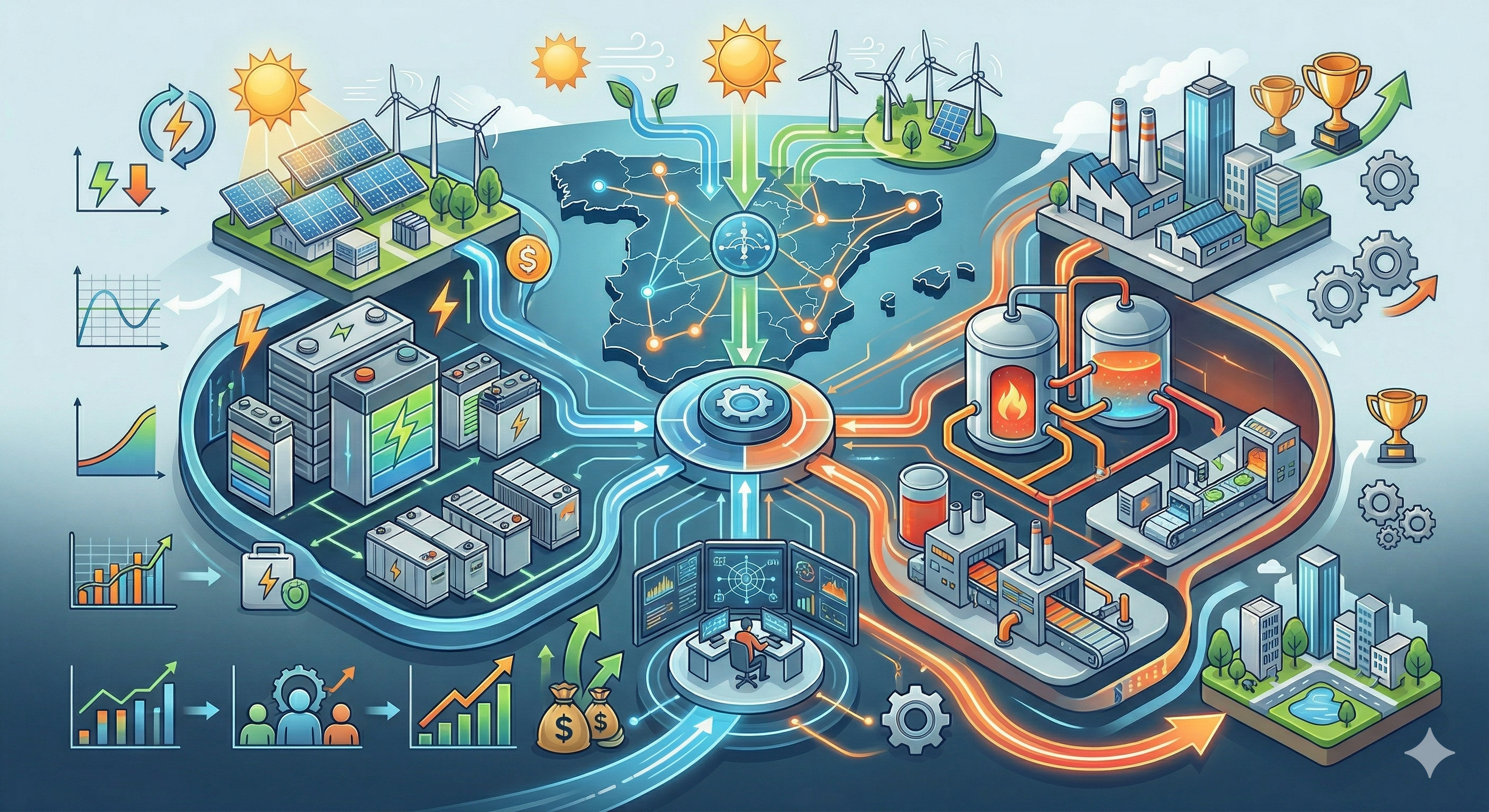
Spain is advancing steadily towards an increasingly renewable electricity system, where flexibility has gone from being a technical concept to becoming an essential element for achieving efficiency and competitiveness.
Currently, it is no longer enough to simply generate and consume energy. Its life cycle has become more complex, and its management plays an increasingly important role. To make this management possible, there is one element that is becoming more and more essential: energy storage.
When generation depends largely on non-dispatchable sources, such as solar photovoltaic, the real challenge is not just producing energy, but increasingly focuses on deciding when to use it. This is where storage ceases to be a complement and becomes a strategic asset within any advanced energy model, especially in industrial and tertiary environments.
Within this field, two main types of storage stand out: electrochemical and thermal, each with its specific applications and advantages.
Electrochemical storage, based mainly on batteries, especially lithium-ion (LFP), has experienced notable development in recent years. The reduction in its cost, close to 45% in stationary applications, has significantly improved its economic viability and accelerated its adoption. Added to this is its ability to respond almost instantaneously, making it a highly effective tool for optimizing photovoltaic self-consumption, shifting consumption to more efficient periods, reducing power peaks, or ensuring supply continuity during micro-outages for critical loads.
Furthermore, in a regulatory environment where it is already possible to participate in flexibility markets with the figure of the independent aggregator, and services such as SRAD already allow monetizing demand management, batteries enable going a step further. They not only optimize consumption but also generate new revenue opportunities. It is no coincidence that the installed capacity of battery storage in Spain has grown strongly, going from around 60 MW at the end of 2025 to more than 120 MW at the beginning of 2026.
For its part, thermal storage promises to play a fundamental role in the decarbonization of industrial processes, especially those where heat has a greater weight. Its main advantage is its ability to store thermal energy from renewable sources, waste heat, or electricity during low-cost hours, to be used later when demand or prices require it.
This approach allows decoupling thermal production and consumption, improving the overall efficiency of the system. Technologies such as Power-to-Heat, which transforms electricity into storable heat, or Power-to-Process, which reuses waste heat from industrial processes, are gaining prominence in this field.
Added to this are solutions such as storage in solid materials reaching high temperatures of over 1,000 ºC or in thermal fluids that reach temperatures of 600 ºC to adapt to different industrial needs.
Beyond their individual applications, the true potential of storage is achieved when integrated into advanced energy management systems. Thanks to tools such as EMS or BMS, facilities cease to be passive structures and become energy assets that anticipate market conditions, optimize their operation, and actively participate in the electricity system.
At Edison Next, we accompany companies in this process, integrating electrochemical and thermal storage solutions within global energy strategies. We combine regulatory knowledge, technology, and data analysis to transform flexibility into a real competitive advantage for our clients. Because in an increasingly dynamic environment, having the right energy at the right time improves operational efficiency and opens the door to new savings opportunities and value generation.
Contact Us
Edison
Next
Information on the processing of your personal data in accordance with the provisions of the General Regulation (EU) 2016/679, on data protection (RGPD) and the L.O. 3/2018, on data protection and guarantee of digital rights (LOPDGDD).
Company Name: EDISON NEXT SPAIN, S.L.U.
Purpose: To respond to your queries and requests.
Legitimacy: Consent expressed by the sender when sending the data via the form provided for this sole purpose.
Rights: You may at any time exercise your right to access, rectification, deletion and portability of the personal data processed by Edison Next, as well as to oppose and limit such processing, by sending a signed request with proof of identity to privacidad@edison.es
Additional information: You can read more detailed information and other additional information in our privacy policy: www.edisonnext.es
